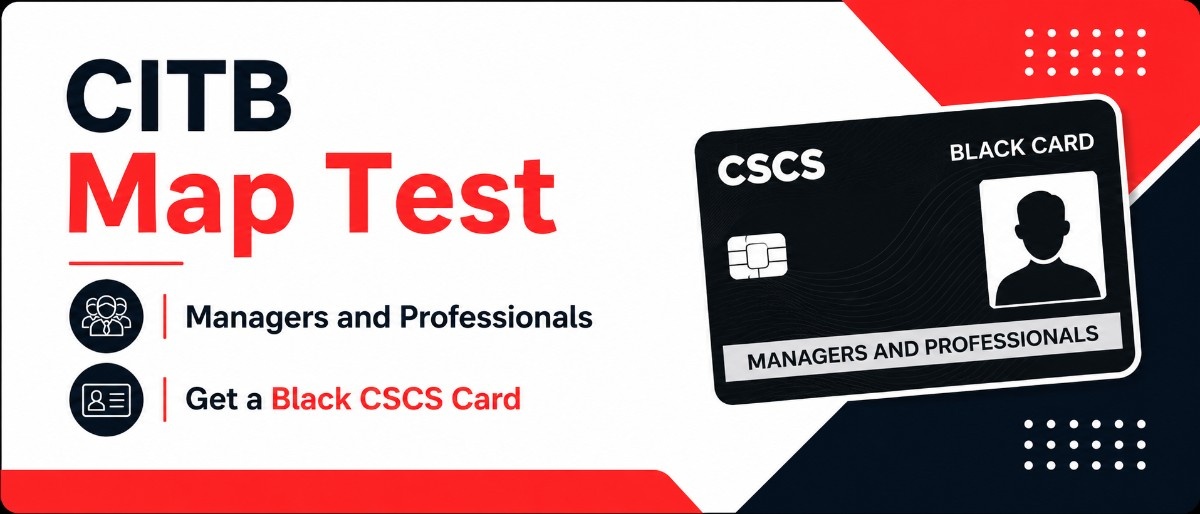
Do you know? What is the CITB MAP test? Know more about key details, who needs it, & how to book the CITB CSCS MAP test with M2HSE Training.
Do you know? What is the CITB MAP test? It is a certification for UK construction managers and professionals. Know about key details, who needs it, & how to book the CITB CSCS MAP test with M2HSE.
The CITB MAP Test (Managers and Professionals) is an advanced Health, Safety, and Environment (HS&E) exam required to obtain higher-tier CSCS cards. It verifies that senior construction personnel understand UK safety legislation, occupational health, and site management practices.
Key Details
Format: 50 multiple-choice questions (including case-study scenarios) taken on a touchscreen.
Duration: 45 minutes.
Pass Mark: 90% (must answer at least 45 out of 50 correctly).
Cost: £23.50.
Who Needs It?
You will typically need to take the MAP test if you are applying for or renewing the following Construction Skills Certification Scheme (CSCS) cards:
Black Card: Contracts Managers, Site Managers (Level 5-7).
White Card (PQP): Professionally Qualified Persons.
White Card (AQP): Academically Qualified Persons.
Book your CITB test for CSCS Black Card: The CSCS Black Card is the highest level of CSCS Card. To obtain it, you need to complete the CITB Test for the CSCS Black Card, also known as the CITB managers and professionals (MAP) test. If you are stepping into a management, supervisory, or professional role within the UK construction industry, you will quickly encounter a specific and highly important certification hurdle. You might be asking yourself, exactly what is the CITB MAP test? In short, it is the ultimate gateway to proving your competence in site safety, environmental awareness, and advanced risk management.
Navigating the complex world of UK construction certifications can sometimes feel like deciphering an alphabet soup. However, passing this specific examination is an absolute necessity if you intend to lead construction sites, manage large teams, or apply for senior-level Construction Skills Certification Scheme (CSCS) cards.
This comprehensive guide breaks down everything you need to know about the test. From booking your exam and mastering the revision material to understanding the exact scoring criteria, we will ensure you walk into the test centre fully prepared.
Understanding the CITB Managers and Professionals Assessment
To begin, we must clarify what the assessment actually entails. The CITB Managers and Professionals Map Health Safety and Environment Test is an advanced-level examination created by the Construction Industry Training Board (CITB). It is specifically engineered to evaluate your knowledge of critical health, safety, and environmental practices at a leadership level.
While operatives and specialists take exams tailored to everyday site tasks, managers face a much broader set of legal and moral responsibilities. The Managers and Professionals health safety and environment test ensures that site leaders do not just know how to keep themselves safe but fully grasp the legal and practical requirements for protecting an entire workforce.
Many candidates simply refer to this assessment as the CITB CSCS map test because passing it is a mandatory prerequisite for obtaining the higher-tier CSCS cards required to step foot on most major UK construction sites in a management capacity.
Why Take the MAP Test? CSCS Cards and Career Progression
Passing this exam is not just a theoretical exercise in ticking boxes; it is directly tied to your career progression, your earning potential, and your site access rights.
The CSCS Black Card
The cscs black card is the gold standard for site management in the UK. Designed specifically for senior site managers, holding this card demonstrates that you possess the relevant NVQ/SVQ Level 4, 5, 6, or 7 in construction management. However, meeting the academic CSCS black card requirements is only half the battle. You are strictly required to pass the MAP test within two years before your application. Without a valid test certificate, your black card application will be automatically rejected.
The CSCS White Card
Alternatively, if you hold a degree, an HND, or are a fully qualified member of an approved professional body (such as the CIOB, ICE, or RICS), you will need to apply for the Academically Qualified Person (AQP) or Professionally Qualified Person (PQP) white card. Similarly, the CSCS white card application process mandates that you submit proof of a valid MAP test pass.
CITB Management Test vs Operative Test: What is the Difference?
A common point of confusion for those new to management roles is the difference between the various levels of CITB testing. When evaluating the CITB management test vs operative test, the primary distinction lies in the scope of responsibility.
The Operative Test: Focuses primarily on personal safety. It asks questions about how to correctly use Personal Protective Equipment (PPE), how to identify basic physical hazards on site, and the importance of following site rules.
The MAP Test: Demands a top-down view of site safety. It assesses your ability to implement corporate policies, fully understand complex health and safety legislation for managers (such as the Construction Design and Management Regulations 2015 and the Health and Safety at Work Act 1974), and oversee site-wide environmental impacts like waste management and noise pollution.
For example, an operative needs to know how to safely erect or use a scaffold. A manager needs to know the legal requirements for scaffold inspections, handover certificates, and how to conduct a thorough risk assessment before the scaffolding is even delivered to the site.
What to Expect: Test Structure and the Pass Mark
To succeed, you must know exactly what you are walking into. The exam lasts for a maximum of 45 minutes and consists of 50 multiple-choice questions.
You must be acutely aware of the CITB MAP test pass mark. To secure a pass, candidates must score an impressive 46 out of 50. This high threshold—requiring a 92% success rate—reflects the critical, life-saving nature of health and safety in management roles. The margin for error is incredibly small, meaning guesswork will absolutely not suffice.
Behavioral Case Study Questions: These assess how you would react to realistic, real-world site scenarios. You will read a short brief about a developing situation on a hypothetical site, and then answer questions detailing the safest, most legally compliant way to handle the problem.
How to Prepare for the CITB MAP Exam?
Preparing for the CITB MAP exam requires a dedicated, structured study strategy. Relying solely on your historical on-site experience is a notoriously risky approach, as the exam focuses heavily on precise legislative wording and official CITB guidelines.
1. Gather Official Revision Materials
Start by acquiring the official CITB MAP test revision material. You should invest in the latest edition of the GT200/MAP revision book, or download the official CITB HS&E test app for Managers and Professionals. The app is particularly useful as it allows you to revise on the go and track your progress.
2. Consider Formal Training Courses
Many professionals benefit immensely from structured educational courses. Looking into options like M2HSE Training can be highly advantageous. These specialised courses explicitly target the advanced knowledge required for the management-level test, breaking down complex legal jargon into digestible, actionable lessons.
3. Utilise Mock Exams
One of the most effective ways to cement your knowledge is by repeatedly taking mock tests using practice questions for managers and professionals. Mock exams familiarise you with the time pressure and the exact wording of the questions. They are especially useful for mastering the behavioural sections, helping you gauge exactly when you are ready to sit the real exam.
The Booking Process: A Step-by-Step Guide
Once you are consistently passing your mock exams, the next step is securing your test slot. If you are wondering how to book CITB test sessions, the process is largely digital and highly streamlined.
Register Online: You can book cscs map test slots directly through the official CITB booking portal, which is operated by their testing partner, Pearson VUE.
Select Your Test Centre: You will need to search for approved Pearson VUE test centre locations. Because Pearson VUE operates a vast network, there are hundreds of accredited testing facilities across the UK, allowing you to easily find a location convenient to your home or current site.
Pay the Examination Fee: The test currently incurs a standard fee of £22.50 (always check the official CITB website for the most up-to-date pricing).
Confirm the Test Type:Crucial Step: Double-check your booking confirmation to ensure you have selected the "Managers and Professionals (MAP)" test, and not the Operative or Specialist exam. Turning up for the wrong test will mean losing your fee and having to rebook.
Test Day Requirements and Retake Policies
To apply for the MAP Test, please visit the official website of M2HSE Training. If you do not pass the test, you will be required to reapply before retaking it. Preparation extends to the morning of your exam. You should aim to arrive at the test centre at least 15 minutes before your scheduled start time to complete the check-in procedures.
Strict CITB test ID requirements are enforced across all test centres. You must bring a valid, primary form of identification bearing both your photograph and your signature. A valid UK driving licence or a current passport are the most widely accepted forms. If you fail to produce the correct, in-date identification, you will be turned away immediately, and your testing fee will be forfeited.
If the test does not go to plan and you score below a 46, do not panic. The official CITB test retake policy allows you to sit the exam again, but you must wait a minimum of 48 hours before your next attempt. Use this waiting period constructively. At the end of your failed attempt, you will receive a score report highlighting the specific topics where you dropped points. Focus your revision entirely on these weaker areas before your next attempt.
After the Test: Validity and Next Steps
As soon as you complete the exam and leave the computer terminal, the testing staff will hand you a printed score report. If you achieve the required 46 points or higher, congratulations are in order!
However, you must be aware of the strict validity period of CITB MAP test passes. Your pass certificate is valid for exactly two years (24 months) from the date you took the test. You must use this pass to apply for your relevant CSCS card within this two-year window. If you allow the certificate to expire before applying for your card, you will have no choice but to sit the test again.
Once your CSCS card application is approved and your card is issued, employers, clients, and site auditors can instantly verify your credentials. They do this using the official CITB Card Checker —a secure online portal and app that confirms the validity of your card, your qualifications, and your health and safety testing status. This real-time checking system ensures total transparency, prevents fraud, and maintains strict compliance across all UK construction sites.
Conclusion
Understanding exactly what the CITB MAP test entails is the vital first step toward advancing your construction career into senior management. As a professional, the physical safety of your workforce and the environmental integrity of your project rest entirely on your shoulders.
By thoroughly understanding the relevant legislation, engaging with high-quality revision materials, and booking your test with confidence, you set yourself up for absolute success. Treat this examination not as an annoying administrative hurdle, but as an opportunity to cement your expertise, update your legal knowledge, and prove yourself as a responsible, highly qualified construction leader.